Cloudy with Chances of Meatballs
-- It's raining FOOD
www.imdb.com/title/tt0844471/
X-Men Origins: Wolverine (2009)
After seeking to live a normal life, Logan sets out to avenge the death of his ...
www.imdb.com/title/tt0458525
Julie & Julia (2009)
"Julie & Julia" is based on the book by the same name, which is based on the true ... I enjoyed seeing the delicious meals both Julia and Julie prepared, ...
www.imdb.com/title/tt1135503/
The Princess and the Frog (2009)
A fairy tale set in Jazz Age-era New Orleans and centered on a young ...
www.imdb.com/title/tt0780521/
The Blind Side (2009)
-- Sandra Bullock, football
www.imdb.com/title/tt0878804/
Sunday, January 31, 2010

Friday, January 29, 2010
How to Install Adobe Flash Player 64-bit on Ubuntu 8.10
http://news.softpedia.com/news/How-to-Install-Adobe-Flash-Player-64-bit-on-Ubuntu-8-10-98076.shtml
eclipse system.out.println shortcut
http://www.java-forums.org/java-tips/3622-eclipse-shortcut-system-out-println.html
Code:
System.out.println();
This is a frequently used statement in Java. If you are working in Eclipse, you can save time using following shortcut:
type: syso
now presss CTRL + SPACE BAR
Enjoy coding.
Code:
System.out.println();
This is a frequently used statement in Java. If you are working in Eclipse, you can save time using following shortcut:
type: syso
now presss CTRL + SPACE BAR
Enjoy coding.
Wednesday, January 27, 2010
Stop Beagle in linux from eating your hard drive
http://beagle-project.org/FAQ#Can_I_disable_Beagle_and_stop_it_from_running.3F
Can I disable Beagle and stop it from running?
If Beagle is started automatically by your distribution, you can usually disable it for a given user by going to the "Search & Indexing" preferences in the control panel or by running the beagle-settings tool and unchecking the "Start search & indexing services automatically" box.
If you want to remove it for all users on the system, the best way is to remove the package from your system. On most distributions it is named beagle.
Can I disable Beagle and stop it from running?
If Beagle is started automatically by your distribution, you can usually disable it for a given user by going to the "Search & Indexing" preferences in the control panel or by running the beagle-settings tool and unchecking the "Start search & indexing services automatically" box.
If you want to remove it for all users on the system, the best way is to remove the package from your system. On most distributions it is named beagle.
set http proxy in console
export http_proxy=http://username:password@proxy.thing.com:8080/
If your web-access is censored by a http proxy, e.g. your web browser requires a http proxy, add the following lines to '~/.subversion/servers':
[groups]
mosuma=svn.mosuma.com
[mosuma]
http-proxy-host=proxy.ntu.edu.sg
http-proxy-port=8080
http://research.mosuma.com/faq/howto/svn_configure_proxy
If your web-access is censored by a http proxy, e.g. your web browser requires a http proxy, add the following lines to '~/.subversion/servers':
[groups]
mosuma=svn.mosuma.com
[mosuma]
http-proxy-host=proxy.ntu.edu.sg
http-proxy-port=8080
http://research.mosuma.com/faq/howto/svn_configure_proxy
Tuesday, January 26, 2010
Set Timex 1440 Sports watch
http://sudoit.blogspot.com/2008/11/set-timex-1440-sports-watch.html
Set Timex 1440 Sports watch
Couldn't find this anywhere on the web (the instruction manual for this watch does not match the watch). After many, many attempts I finally figured it out:
Press and hold the mode button for a few seconds, then, press the mode button again!
The 'set' button then changes the value while the 'start/stop' button will advance to the next thing to set.
Set the Timex 1440 Sports Watch (wr50m) Magnetism watch
hold down the "mode" button for 2 seconds. When the digits on the watch face start to blink, then press the "mode" button again. To change the hours, press the "adjust button". [instructions thanks to a comment below]
Posted by JTP at 7:56 PM
Labels: howto set 1440 Timex sports watch instructions
Set Timex 1440 Sports watch
Couldn't find this anywhere on the web (the instruction manual for this watch does not match the watch). After many, many attempts I finally figured it out:
Press and hold the mode button for a few seconds, then, press the mode button again!
The 'set' button then changes the value while the 'start/stop' button will advance to the next thing to set.
Set the Timex 1440 Sports Watch (wr50m) Magnetism watch
hold down the "mode" button for 2 seconds. When the digits on the watch face start to blink, then press the "mode" button again. To change the hours, press the "adjust button". [instructions thanks to a comment below]
Posted by JTP at 7:56 PM
Labels: howto set 1440 Timex sports watch instructions
Protein core, attachments, protein complex
http://www.ncbi.nlm.nih.gov/pubmed/18282471?log$=activity
Interaction networks for systems biology.
Bader S, Kühner S, Gavin AC.
EMBL, Structural and Computational Biology Unit, Meyerhofstrasse 1, D-69117 Heidelberg, Germany.
Cellular functions are almost always the result of the coordinated action of several proteins, interacting in protein complexes, pathways or networks. Progress made in devising suitable tools for analysis of protein-protein interactions, have recently made it possible to chart interaction networks on a large-scale. The aim of this review is to provide a short overview of the most promising contributions of interaction networks to human biology, structural biology and human genetics.
http://www.liebertonline.com/doi/abs/10.1089/cmb.2008.01TTJournal of Computational Biology
Predicting Protein Complexes from PPI Data: A Core-Attachment Approach
To cite this article:
Henry C.M. Leung, Qian Xiang, S.M. Yiu, Francis Y.L. Chin. Journal of Computational Biology. February 2009, 16(2): 133-144. doi:10.1089/cmb.2008.01TT.
http://string.embl.de/
STRING
Interaction networks for systems biology.
Bader S, Kühner S, Gavin AC.
EMBL, Structural and Computational Biology Unit, Meyerhofstrasse 1, D-69117 Heidelberg, Germany.
Cellular functions are almost always the result of the coordinated action of several proteins, interacting in protein complexes, pathways or networks. Progress made in devising suitable tools for analysis of protein-protein interactions, have recently made it possible to chart interaction networks on a large-scale. The aim of this review is to provide a short overview of the most promising contributions of interaction networks to human biology, structural biology and human genetics.
http://www.liebertonline.com/doi/abs/10.1089/cmb.2008.01TTJournal of Computational Biology
Predicting Protein Complexes from PPI Data: A Core-Attachment Approach
To cite this article:
Henry C.M. Leung, Qian Xiang, S.M. Yiu, Francis Y.L. Chin. Journal of Computational Biology. February 2009, 16(2): 133-144. doi:10.1089/cmb.2008.01TT.
http://string.embl.de/
STRING
Monday, January 25, 2010
Table of logic symbols
http://en.wikipedia.org/wiki/Table_of_logic_symbols
implies; if .. then
⇒
→
⊃
http://en.wikipedia.org/wiki/First-order_logic

Every propositional wff α can be converted into a formula α′ in
Conjunctive Normal Form (CNF) in such a way that |= α ≡ α′.
1. eliminate ⊃ and ≡ using (α ⊃ β) -> (¬α ∨ β) etc.
2. push ¬ inward using ¬(α ∧ β) -> (¬α ∨ ¬β) etc.
3. distribute ∨ over ∧ using ((α ∧ β) ∨ γ) -> ((α ∨ γ) ∧ (β ∨ γ))
4. collect terms using (α ∨ α) -> α etc.
http://en.wikipedia.org/wiki/Conjunctive_normal_form
http://www.enm.bris.ac.uk/ai/enjl/
http://www.enm.bris.ac.uk/ai/enjl/logic1.pdf
• 1. The connectives → and ↔ are eliminated using the equivalences
A ↔ B ≡ ( A → B) ∧ (B → A) and then A → B ≡ (¬ A∨ B)
• 2. Secondly, De Morgan’s Laws are applied as widely as possible
¬( A∧ B) is replaced by (¬ A∨ ¬ B)
¬( A∨ B) is replaced by (¬ A∧ ¬ B)
• 3. Multiple negations are reduced using DNEG e.g. ¬¬ A is replaced by A
• 4. The DISTOR rule is frequently applied
After the above procedures have been applied the original sentence is in conjunctive
normal form. Further simplifications can then be made by applying rule 1 (section 4) to
eliminate tautologies e.g. ((¬ A∨ A) ∧ B) ≡ B and repetitions within a clause can be
suppressed using IDOR e.g. A∨ A∨ A ≡ A. Also, if, in a normal form, a clause Ci is
included in another clause C j , the COR and AOR mean that the clausal brackets can be
removed e.g. (( A∨ B) ∨ D) ≡ ( A∨ B∨ D) ≡ ( A∨ ( B∨ D)) etc. Finally rule 1 can be used to
reduce a normal form containing a logically false clause to a logically false clause. Forms
simplified by the above procedures are said to be pure normal forms.
6. ≡ ((P ∧ ¬R) ∧ Q) ∨ (( ¬P ∨ R) ∨ ¬S)
7. ≡ (¬ ( ¬P ∨R ) ∧ Q ) ∨ ( (¬P ∨ R ) ∨ ¬S)8. ≡ ((¬( ¬P ∨ R ) ∧ Q ) ∨ (¬P ∨ R )) ∨ ¬S
9. ((¬ (¬P ∨ R ) ∧ Q) ∨ ( ¬P ∨ R)) ≡ ( Q ∨ ( ¬P ∨R ))
10. ((¬ (¬P ∨ R ) ∧ Q) ∨ ( ¬P ∨ R)) ∨ ¬S ≡ Q ∨¬P ∨ R ∨ ¬S
Skolemization
∃x∀yR(x,y) |= ∀y∃xR(x,y)
∀y∃xR(x,y) |≠ ∃x∀yR(x,y)
∃x∀y∃zP(x,y,z) to ∀yP(a,y,f(y))
Abbreviations:
(α ⊃ β) for (¬α ∨ β)
safer to read as disjunction than as “if ... then ...”
(α ≡ β) for ((α⊃β) ∧ (β⊃α))
implies; if .. then
⇒
→
⊃
http://en.wikipedia.org/wiki/First-order_logic

Every propositional wff α can be converted into a formula α′ in
Conjunctive Normal Form (CNF) in such a way that |= α ≡ α′.
1. eliminate ⊃ and ≡ using (α ⊃ β) -> (¬α ∨ β) etc.
2. push ¬ inward using ¬(α ∧ β) -> (¬α ∨ ¬β) etc.
3. distribute ∨ over ∧ using ((α ∧ β) ∨ γ) -> ((α ∨ γ) ∧ (β ∨ γ))
4. collect terms using (α ∨ α) -> α etc.
http://en.wikipedia.org/wiki/Conjunctive_normal_form
http://www.enm.bris.ac.uk/ai/enjl/
http://www.enm.bris.ac.uk/ai/enjl/logic1.pdf
• 1. The connectives → and ↔ are eliminated using the equivalences
A ↔ B ≡ ( A → B) ∧ (B → A) and then A → B ≡ (¬ A∨ B)
• 2. Secondly, De Morgan’s Laws are applied as widely as possible
¬( A∧ B) is replaced by (¬ A∨ ¬ B)
¬( A∨ B) is replaced by (¬ A∧ ¬ B)
• 3. Multiple negations are reduced using DNEG e.g. ¬¬ A is replaced by A
• 4. The DISTOR rule is frequently applied
After the above procedures have been applied the original sentence is in conjunctive
normal form. Further simplifications can then be made by applying rule 1 (section 4) to
eliminate tautologies e.g. ((¬ A∨ A) ∧ B) ≡ B and repetitions within a clause can be
suppressed using IDOR e.g. A∨ A∨ A ≡ A. Also, if, in a normal form, a clause Ci is
included in another clause C j , the COR and AOR mean that the clausal brackets can be
removed e.g. (( A∨ B) ∨ D) ≡ ( A∨ B∨ D) ≡ ( A∨ ( B∨ D)) etc. Finally rule 1 can be used to
reduce a normal form containing a logically false clause to a logically false clause. Forms
simplified by the above procedures are said to be pure normal forms.
6. ≡ ((P ∧ ¬R) ∧ Q) ∨ (( ¬P ∨ R) ∨ ¬S)
7. ≡ (¬ ( ¬P ∨R ) ∧ Q ) ∨ ( (¬P ∨ R ) ∨ ¬S)8. ≡ ((¬( ¬P ∨ R ) ∧ Q ) ∨ (¬P ∨ R )) ∨ ¬S
9. ((¬ (¬P ∨ R ) ∧ Q) ∨ ( ¬P ∨ R)) ≡ ( Q ∨ ( ¬P ∨R ))
10. ((¬ (¬P ∨ R ) ∧ Q) ∨ ( ¬P ∨ R)) ∨ ¬S ≡ Q ∨¬P ∨ R ∨ ¬S
Skolemization
∃x∀yR(x,y) |= ∀y∃xR(x,y)
∀y∃xR(x,y) |≠ ∃x∀yR(x,y)
∃x∀y∃zP(x,y,z) to ∀yP(a,y,f(y))
Abbreviations:
(α ⊃ β) for (¬α ∨ β)
safer to read as disjunction than as “if ... then ...”
(α ≡ β) for ((α⊃β) ∧ (β⊃α))
Movies
Ice Castles (1978) -- Robby Benson as Nick, Lynn-Holly Johnson as Alexis Winston
Theme Song: (Through the Eyes of Love) - Melissa Manchester
http://www.youtube.com/watch?v=WvP8u-9QX5s
Songwriter(s): Carole Bayer-Sager, Marvin Hamlisch
Please, don't let this feeling end
It's everything I am,
Everything I wanna be;
I can see what's mine now
Finding out what's true,
Since I've found you
Lookin' through the eyes of love.
Story about an ice skater who went blend, pretty good movie
http://www.imdb.com/title/tt0077716/
----
Up (2009)
Story about a widowed old man Mr. Carl Fredricksen, accompanied by an explorer kid, Russell as they transport their house over to Paradise Falls with lots and lots of balloons.
http://www.imdb.com/title/tt1049413/
Theme Song: (Through the Eyes of Love) - Melissa Manchester
http://www.youtube.com/watch?v=WvP8u-9QX5s
Songwriter(s): Carole Bayer-Sager, Marvin Hamlisch
Please, don't let this feeling end
It's everything I am,
Everything I wanna be;
I can see what's mine now
Finding out what's true,
Since I've found you
Lookin' through the eyes of love.
Story about an ice skater who went blend, pretty good movie
http://www.imdb.com/title/tt0077716/
----
Up (2009)
Story about a widowed old man Mr. Carl Fredricksen, accompanied by an explorer kid, Russell as they transport their house over to Paradise Falls with lots and lots of balloons.
http://www.imdb.com/title/tt1049413/
Wednesday, January 20, 2010
kr - resolution logic
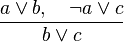
http://en.wikipedia.org/wiki/Resolution_(logic)
A simple example
\frac{a \vee b, \quad \neg a \vee c} {b \vee c}
In English: if a or b is true, and a is false or c is true, then either b or c is true.
If a is true, then for the second premise to hold, c must be true. If a is false, then for the first premise to hold, b must be true.
So regardless of a, if both premises hold, then b or c is true.
Claim: Resolvent is entailed by input clauses.
Suppose I |= (p ∨ α) and I |= (¬p ∨ β)
I |= p
Case 1:
then I | = β, so I |= (α ∨ β).
I |≠ p
Case 2:
then I | = α, so I | = (α ∨ β).
I | = (α ∨ β).
Either way,
{(p ∨ α), (¬p ∨ β)} |= (α ∨ β).
So:
ch4. informed search and explorartion
Heuristic search algorithms
----------------------------------------------------------
best first-search, uses evaluation function f(n) and heuristic function h(n) - estimated cost from n to the goal
Greedy best-first search f(n) = h(n), can go to infinite loop
A* search = f(n) = g(n) + h(n), optimal if h(n) is admissible ie h(n) <= h*(n)
consistent if h(n) <= c(n,a,n') + h(n')
h(G) = 0
e.g. shortest path from Arad to Bucharest, 8-puzzle sliding tile
A* (like breadth first) is complete and optimal, large space (keeps all nodes in memory) and time complexity, it needs to expand ALL fn <= C* (inside the contour) before expanding the next contour
trees don't loop (because childs are not connected with each other) (for A*, h(n) only needs to be admissible) but graphs can loop so graphs need to be more restrictive (for A*, it h(n) needs to be consistent), if h(n) is consistent then it's admissible but not the other way around ...
Local search and optimization / Iterative improvement algorithms - eg. n-queens
------------------------------------------------------------------------
local search algorithms (use when paths are irrelevant) operate a single current state (rather than multiple paths) and tries to improve it, generally move only to neighbours of that state, unsystematic, paths followed are not retained -> use less memory; also find solutions in large or infinite state spaces eg. nxn-queens problem, think of the state space landscape (hills), it doesn't matter how you got there, just that you got there.
hill-climbing search is like a greedy local search, it grabs a good neighbour state without thinking ahead about where to go next., fast but it gets stuck at local maxima sometimes, needs some restarting. gradient descent is like hill-climbing but it finds the minima. gradient descent is like a ping-pong ball falling down to a hole where the surface is bumpy.
simulated annealing is where you shake the surface a lot in the beginning (high temp) and then gradually reduce the intensity of shaking (lower temp.) over long period of time, so more bad moves are allowed at the beginning and as temperature T decreases, bad moves are less favoured. If T decreases slowly enough, the algorithm will find a global optimum approaching 1.
local beam search keeps track of k states rather than just one, starts off with k randomly generated states, at each step, all the successors of all k states are generated, if any one is a goal, the algorithm halts. Otherwise, it picks the k best successors from the complete list and repeats so useful information is passed among the k parallel search (not the case with a random-walk)
genetic algorithms is like a stochastic beam search in which successor states are generated by combining two parent states, rather than by modifying a single state, so it's like natural selection using sexual reproduction, operations include, 1) initial population 2) fitness function 3) selection 4) crossovers 5) mutations.
----------------------------------------------------------
best first-search, uses evaluation function f(n) and heuristic function h(n) - estimated cost from n to the goal
Greedy best-first search f(n) = h(n), can go to infinite loop
A* search = f(n) = g(n) + h(n), optimal if h(n) is admissible ie h(n) <= h*(n)
consistent if h(n) <= c(n,a,n') + h(n')
h(G) = 0
e.g. shortest path from Arad to Bucharest, 8-puzzle sliding tile
A* (like breadth first) is complete and optimal, large space (keeps all nodes in memory) and time complexity, it needs to expand ALL fn <= C* (inside the contour) before expanding the next contour
trees don't loop (because childs are not connected with each other) (for A*, h(n) only needs to be admissible) but graphs can loop so graphs need to be more restrictive (for A*, it h(n) needs to be consistent), if h(n) is consistent then it's admissible but not the other way around ...
Local search and optimization / Iterative improvement algorithms - eg. n-queens
------------------------------------------------------------------------
local search algorithms (use when paths are irrelevant) operate a single current state (rather than multiple paths) and tries to improve it, generally move only to neighbours of that state, unsystematic, paths followed are not retained -> use less memory; also find solutions in large or infinite state spaces eg. nxn-queens problem, think of the state space landscape (hills), it doesn't matter how you got there, just that you got there.
hill-climbing search is like a greedy local search, it grabs a good neighbour state without thinking ahead about where to go next., fast but it gets stuck at local maxima sometimes, needs some restarting. gradient descent is like hill-climbing but it finds the minima. gradient descent is like a ping-pong ball falling down to a hole where the surface is bumpy.
simulated annealing is where you shake the surface a lot in the beginning (high temp) and then gradually reduce the intensity of shaking (lower temp.) over long period of time, so more bad moves are allowed at the beginning and as temperature T decreases, bad moves are less favoured. If T decreases slowly enough, the algorithm will find a global optimum approaching 1.
local beam search keeps track of k states rather than just one, starts off with k randomly generated states, at each step, all the successors of all k states are generated, if any one is a goal, the algorithm halts. Otherwise, it picks the k best successors from the complete list and repeats so useful information is passed among the k parallel search (not the case with a random-walk)
genetic algorithms is like a stochastic beam search in which successor states are generated by combining two parent states, rather than by modifying a single state, so it's like natural selection using sexual reproduction, operations include, 1) initial population 2) fitness function 3) selection 4) crossovers 5) mutations.
Tuesday, January 19, 2010
Math Proofs
http://www.wikihow.com/Do-Math-Proofs
# Realize that a proof is just a good argument with every step justified. You can see about 50 proofs online [2].
# A good mathematical proof makes every step really obvious. Impressive-sounding statements might get marks in other subjects, but in mathematics they tend to hide holes in the reasoning.
http://www.physicsforums.com/showthread.php?t=166996
http://zimmer.csufresno.edu/~larryc/proofs/proofs.html
# Realize that a proof is just a good argument with every step justified. You can see about 50 proofs online [2].
# A good mathematical proof makes every step really obvious. Impressive-sounding statements might get marks in other subjects, but in mathematics they tend to hide holes in the reasoning.
http://www.physicsforums.com/showthread.php?t=166996
http://zimmer.csufresno.edu/~larryc/proofs/proofs.html
Monday, January 18, 2010
粉雪 - Konayuki - Powdered Snow
http://wiki.d-addicts.com/Konayuki
Konayuki
* Title: 粉雪
* Title (Romaji): Konayuki
* Title (English): Powdered Snow
* Lyrics/Music: Fujimaki Ryota
* Vocal: Remioromen
* Related TV Show: Ichi Rittoru no Namida (1 Litre of Tears)
Konayuki
* Title: 粉雪
* Title (Romaji): Konayuki
* Title (English): Powdered Snow
* Lyrics/Music: Fujimaki Ryota
* Vocal: Remioromen
* Related TV Show: Ichi Rittoru no Namida (1 Litre of Tears)
Subscribe to:
Posts (Atom)