$ sudo apt-get install festival
$ sudo echo "Hello world." | festival --tts
$ sudo dpkg --force-architecture --install AdbeRdr9.3.4-1_i386linux_enu.deb
navaburo
5 Cups of Ubuntu
navaburo's Avatar
Join Date: Oct 2007
Location: Hoboken, NJ
Beans: 38
Ubuntu 7.10 Gutsy Gibbon
SOLUTION: "Linux: can't open /dev/dsp"
Why festival uses the outdated /dev/dsp (OSS emulation) is beyond me.
To make it use ALSA, do the following:
Code:
printf ";use ALSA\n(Parameter.set 'Audio_Method 'Audio_Command)\n(Parameter.set 'Audio_Command \"aplay -q -c 1 -t raw -f s16 -r \$SR \$FILE\")\n" > .festivalrc
Then you can listen to music and use festival simultaneously.
Then run
http://ubuntuforums.org/showthread.php?t=171182&page=2
Wednesday, September 15, 2010

Next-gen sequencing
Videos
http://www.youtube.com/watch?v=oYpllbI0qF8
http://gep.wustl.edu/curriculum/course_materials/gscmaterials_next.php
http://en.wikipedia.org/wiki/Shotgun_sequencing#Whole_genome_shotgun_sequencing
Coverage is the average number of reads representing a given nucleotide in the reconstructed sequence. It can be calculated from the length of the original genome (G), the number of reads(N), and the average read length(L) as NL / G. For example, a hypothetical genome with 2,000 base pairs reconstructed from 8 reads with an average length of 500 nucleotides will have 2x redundancy.
next-gen sequencing has high coverage due to the high number of reads (but with shorter read lengths (anywhere from 25–500bp)) in a short amount of time and cheaper by parallelizing the sequencing process. assembly of these short reads is computationally expensive.
depth - number of sequence reads produced
http://en.wikipedia.org/wiki/Next-generation_sequencing#New_sequencing_methods
http://en.wikipedia.org/wiki/Pyrosequencing
Pyrosequencing is a method of DNA sequencing (determining the order of nucleotides in DNA) based on the "sequencing by synthesis" principle.
"Sequencing by synthesis" involves taking a single strand of the DNA to be sequenced and then synthesizing its complementary strand enzymatically. The Pyrosequencing method is based on detecting the activity of DNA polymerase (a DNA synthesizing enzyme) with another chemiluminescent enzyme. Essentially, the method allows sequencing of a single strand of DNA by synthesizing the complementary strand along it, one base pair at a time, and detecting which base was actually added at each step. The template DNA is immobile, and solutions of A, C, G, and T nucleotides are added and removed after the reaction, sequentially. Light is produced only when the nucleotide solution complements the first unpaired base of the template. The sequence of solutions which produce chemiluminescent signals allows the determination of the sequence of the template.
High-throughput sequencing
The high demand for low-cost sequencing has driven the development of high-throughput sequencing technologies that parallelize the sequencing process, producing thousands or millions of sequences at once.[20][21] High-throughput sequencing technologies are intended to lower the cost of DNA sequencing beyond what is possible with standard dye-terminator methods.[22]
[edit] 454 pyrosequencing
Main article: 454 Life Sciences#Technology
A parallelized version of pyrosequencing was developed by 454 Life Sciences. The method amplifies DNA inside water droplets in an oil solution (emulsion PCR), with each droplet containing a single DNA template attached to a single primer-coated bead that then forms a clonal colony. The sequencing machine contains many picolitre-volume wells each containing a single bead and sequencing enzymes. Pyrosequencing uses luciferase to generate light for detection of the individual nucleotides added to the nascent DNA, and the combined data are used to generate sequence read-outs.[16] This technology provides intermediate read length and price per base compared to Sanger sequencing on one end and Solexa and SOLiD on the other.[23]
[edit] Solexa sequencing
Solexa has developed a sequencing technology based on reversible dye-terminators. DNA molecules are first attached to primers on a slide and amplified so that local clonal colonies are formed (bridge amplification). One type of nucleotide at a time is then added, and non-incorporated nucleotides are washed away. Unlike pyrosequencing, the DNA can only be extended one nucleotide at a time. A camera takes images of the fluorescently labeled nucleotides and the dye is chemically removed from the DNA, allowing a next cycle.[24]
[edit] SOLiD sequencing
Main article: ABI Solid Sequencing
Applied Biosystems' SOLiD technology employs sequencing by ligation. Here, a pool of all possible oligonucleotides of a fixed length are labeled according to the sequenced position. Oligonucleotides are annealed and ligated; the preferential ligation by DNA ligase for matching sequences results in a signal informative of the nucleotide at that position. Before sequencing, the DNA is amplified by emulsion PCR. The resulting bead, each containing only copies of the same DNA molecule, are deposited on a glass slide.[25] Similar to Solexa sequencing, this technology produces short read lengths at a low price per base.[23]
http://www.youtube.com/watch?v=nFfgWGFe0aA
amplicon sequencing - ultra deep, detect mutations at low level frequency in cancers
http://en.wikipedia.org/wiki/454_Life_Sciences#Amplicon_Sequencing
454 weakness:
A limitation of 454 sequencing remains resolution of homopolymer DNA segments; i.e. regions of template which contain multiple consecutive copies of a single base (A, C, G or T). Since pyrosequencing relies on the magnitude of light emitted to determine the number of repetitive bases, erroneous base calls can be a problem with homopolymers. Another disadvantage of 454 sequencing is that while it is cheaper and faster per base, each run is quite expensive, and it is therefore unsuited for sequencing targeted fragments from small numbers of DNA samples, such as for phylogenetic analysis
http://www.youtube.com/watch?v=oYpllbI0qF8
http://gep.wustl.edu/curriculum/course_materials/gscmaterials_next.php
http://en.wikipedia.org/wiki/Shotgun_sequencing#Whole_genome_shotgun_sequencing
Coverage is the average number of reads representing a given nucleotide in the reconstructed sequence. It can be calculated from the length of the original genome (G), the number of reads(N), and the average read length(L) as NL / G. For example, a hypothetical genome with 2,000 base pairs reconstructed from 8 reads with an average length of 500 nucleotides will have 2x redundancy.
next-gen sequencing has high coverage due to the high number of reads (but with shorter read lengths (anywhere from 25–500bp)) in a short amount of time and cheaper by parallelizing the sequencing process. assembly of these short reads is computationally expensive.
depth - number of sequence reads produced
http://en.wikipedia.org/wiki/Next-generation_sequencing#New_sequencing_methods
http://en.wikipedia.org/wiki/Pyrosequencing
Pyrosequencing is a method of DNA sequencing (determining the order of nucleotides in DNA) based on the "sequencing by synthesis" principle.
"Sequencing by synthesis" involves taking a single strand of the DNA to be sequenced and then synthesizing its complementary strand enzymatically. The Pyrosequencing method is based on detecting the activity of DNA polymerase (a DNA synthesizing enzyme) with another chemiluminescent enzyme. Essentially, the method allows sequencing of a single strand of DNA by synthesizing the complementary strand along it, one base pair at a time, and detecting which base was actually added at each step. The template DNA is immobile, and solutions of A, C, G, and T nucleotides are added and removed after the reaction, sequentially. Light is produced only when the nucleotide solution complements the first unpaired base of the template. The sequence of solutions which produce chemiluminescent signals allows the determination of the sequence of the template.
High-throughput sequencing
The high demand for low-cost sequencing has driven the development of high-throughput sequencing technologies that parallelize the sequencing process, producing thousands or millions of sequences at once.[20][21] High-throughput sequencing technologies are intended to lower the cost of DNA sequencing beyond what is possible with standard dye-terminator methods.[22]
[edit] 454 pyrosequencing
Main article: 454 Life Sciences#Technology
A parallelized version of pyrosequencing was developed by 454 Life Sciences. The method amplifies DNA inside water droplets in an oil solution (emulsion PCR), with each droplet containing a single DNA template attached to a single primer-coated bead that then forms a clonal colony. The sequencing machine contains many picolitre-volume wells each containing a single bead and sequencing enzymes. Pyrosequencing uses luciferase to generate light for detection of the individual nucleotides added to the nascent DNA, and the combined data are used to generate sequence read-outs.[16] This technology provides intermediate read length and price per base compared to Sanger sequencing on one end and Solexa and SOLiD on the other.[23]
[edit] Solexa sequencing
Solexa has developed a sequencing technology based on reversible dye-terminators. DNA molecules are first attached to primers on a slide and amplified so that local clonal colonies are formed (bridge amplification). One type of nucleotide at a time is then added, and non-incorporated nucleotides are washed away. Unlike pyrosequencing, the DNA can only be extended one nucleotide at a time. A camera takes images of the fluorescently labeled nucleotides and the dye is chemically removed from the DNA, allowing a next cycle.[24]
[edit] SOLiD sequencing
Main article: ABI Solid Sequencing
Applied Biosystems' SOLiD technology employs sequencing by ligation. Here, a pool of all possible oligonucleotides of a fixed length are labeled according to the sequenced position. Oligonucleotides are annealed and ligated; the preferential ligation by DNA ligase for matching sequences results in a signal informative of the nucleotide at that position. Before sequencing, the DNA is amplified by emulsion PCR. The resulting bead, each containing only copies of the same DNA molecule, are deposited on a glass slide.[25] Similar to Solexa sequencing, this technology produces short read lengths at a low price per base.[23]
http://www.youtube.com/watch?v=nFfgWGFe0aA
amplicon sequencing - ultra deep, detect mutations at low level frequency in cancers
http://en.wikipedia.org/wiki/454_Life_Sciences#Amplicon_Sequencing
454 weakness:
A limitation of 454 sequencing remains resolution of homopolymer DNA segments; i.e. regions of template which contain multiple consecutive copies of a single base (A, C, G or T). Since pyrosequencing relies on the magnitude of light emitted to determine the number of repetitive bases, erroneous base calls can be a problem with homopolymers. Another disadvantage of 454 sequencing is that while it is cheaper and faster per base, each run is quite expensive, and it is therefore unsuited for sequencing targeted fragments from small numbers of DNA samples, such as for phylogenetic analysis
Tuesday, September 14, 2010
Ten Simple Rules for Good Presentations
Ten Simple Rules for Good Presentations
1. Talk to the audience - know who the audience is
2. Less is more - save your knowledge to Q&A
3. Talk only when you have something to say -
4. Take home message - audience remember 3 points week later
5. Tell a story, be logical
6. Treat the talk as a stage - don't be funny when you're not
7. Time your presentation and stick to it
8. Use visual sparingly and effectively, they are only supplement, 1 slide per minute
9. Review audio and video of your presentation
10. Provide acknowledgement
http://www.scivee.tv/node/2903
Make them think what you've done.
1. Talk to the audience - know who the audience is
2. Less is more - save your knowledge to Q&A
3. Talk only when you have something to say -
4. Take home message - audience remember 3 points week later
5. Tell a story, be logical
6. Treat the talk as a stage - don't be funny when you're not
7. Time your presentation and stick to it
8. Use visual sparingly and effectively, they are only supplement, 1 slide per minute
9. Review audio and video of your presentation
10. Provide acknowledgement
http://www.scivee.tv/node/2903
Make them think what you've done.
Bisulfite sequencing
Bisulfite sequencing is the use of bisulfite treatment of DNA to determine its pattern of methylation. DNA methylation was the first discovered epigenetic mark, and remains the most studied. In animals it predominantly involves the addition of a methyl group to the carbon-5 position of cytosine residues of the dinucleotide CpG, and is implicated in repression of transcriptional activity.
Treatment of DNA with bisulfite converts cytosine residues to uracil, but leaves 5-methylcytosine residues unaffected. Thus, bisulfite treatment introduces specific changes in the DNA sequence that depend on the methylation status of individual cytosine residues, yielding single- nucleotide resolution information about the methylation status of a segment of DN
Treatment of DNA with bisulfite converts cytosine residues to uracil, but leaves 5-methylcytosine residues unaffected. Thus, bisulfite treatment introduces specific changes in the DNA sequence that depend on the methylation status of individual cytosine residues, yielding single- nucleotide resolution information about the methylation status of a segment of DN
CpG
http://en.wikipedia.org/wiki/CpG_island
In genetics, CpG islands are genomic regions that contain a high frequency of CpG sites but to date objective definitions for CpG islands are limited. In mammalian genomes, CpG islands are typically 300-3,000 base pairs in length. They are in and near approximately 40% of promoters of mammalian genes.[1] About 70% of human promoters have a high CpG content. Given the GC frequency however, the number of CpG dinucleotides is much lower than expected.[2] The "p" in CpG refers to the phosphodiester bond between the cytosine and the guanine, which indicates that the C and the G are next to each other on the sequence strand be it a single or double stranded.
http://www.ncbi.nlm.nih.gov/pmc/articles/PMC1345710/?tool=pmcentrez
CpG oligodeoxynucleotides (or CpG ODN) are short single stranded synthetic DNA molecules that contain a cytosine "C" followed by a guanine "G". The "p" refers to the phosphodiester backbone of DNA, however some ODN have a modified phosphorothioate (PS) backbone. When these CpG motifs are unmethlyated, they act as immunostimulants.[1] CpG motifs are considered pathogen-associated molecular patterns (PAMPs) due to their abundance in microbial genomes but their rarity in vertebrate genomes.[2] The CpG PAMP is recognized by the pattern recognition receptor (PRR) Toll-Like Receptor 9 (TLR9), which is only constitutively expressed in B cells and plasmacytoid dendritic cells (pDCs) in humans and other higher primates.[3]
http://en.wikipedia.org/wiki/CpG_Oligodeoxynucleotide
In genetics, CpG islands are genomic regions that contain a high frequency of CpG sites but to date objective definitions for CpG islands are limited. In mammalian genomes, CpG islands are typically 300-3,000 base pairs in length. They are in and near approximately 40% of promoters of mammalian genes.[1] About 70% of human promoters have a high CpG content. Given the GC frequency however, the number of CpG dinucleotides is much lower than expected.[2] The "p" in CpG refers to the phosphodiester bond between the cytosine and the guanine, which indicates that the C and the G are next to each other on the sequence strand be it a single or double stranded.
http://www.ncbi.nlm.nih.gov/pmc/articles/PMC1345710/?tool=pmcentrez
CpG oligodeoxynucleotides (or CpG ODN) are short single stranded synthetic DNA molecules that contain a cytosine "C" followed by a guanine "G". The "p" refers to the phosphodiester backbone of DNA, however some ODN have a modified phosphorothioate (PS) backbone. When these CpG motifs are unmethlyated, they act as immunostimulants.[1] CpG motifs are considered pathogen-associated molecular patterns (PAMPs) due to their abundance in microbial genomes but their rarity in vertebrate genomes.[2] The CpG PAMP is recognized by the pattern recognition receptor (PRR) Toll-Like Receptor 9 (TLR9), which is only constitutively expressed in B cells and plasmacytoid dendritic cells (pDCs) in humans and other higher primates.[3]
http://en.wikipedia.org/wiki/CpG_Oligodeoxynucleotide
The seven habits of highly effective data users
Volume 118, Issue 2, Pages 144-158 (February 1998)
The seven habits of highly effective data users
MD, MPH Richard M. Rosenfeld
The seven habits are
(1) check quality before quantity,
(2) describe before you analyze,
(3) accept the uncertainty of all data,
(4) measure error with the right statistical test,
(5) put clinical importance before statistical significance,
(6) seek the sample source, and
(7) view science as a cumulative process.
The seven habits of highly effective data users
MD, MPH Richard M. Rosenfeld
The seven habits are
(1) check quality before quantity,
(2) describe before you analyze,
(3) accept the uncertainty of all data,
(4) measure error with the right statistical test,
(5) put clinical importance before statistical significance,
(6) seek the sample source, and
(7) view science as a cumulative process.
When something goes wrong in Linux
1. I have the “force quit” applet on my taskbar, if any app starts to act up just click on the “force quit” icon and then kill the app
2. If that doesn’t work, draw up a terminal and type “ps -A” , and take note of the Process ID (PID) of the culprit app, then kill it. “kill PID”
3. Use the “killall” command, for example, “killall firefox-bin”
4. If your whole GUI is frozen, and drawing up a terminal is impossible, then press CTRL-ALT-F1, this will take you to another terminal, and virtually a whole new session. From there kill the culprit app using step 2 and 3.
5. If that doesn’t work, you might want to restart your GUI using the CTRL-ALT-Backspace combo. Beware, that this will kill all your GUI apps currently running
6. Invoke CTRL-ALT-F1 and do CTRL+ALT+DEL from here. This will not instantly reset your system, merely perform a standard reboot, it’s safe. (Assuming you want to restart and CTLR-ALT-F1 works)
7. Finally if nothing works, don’t rush to the hard reset button, try to Raise a Skinny Elephant
http://linuxologist.com/1general/the-7-habits-of-highly-effective-linux-users/
2. If that doesn’t work, draw up a terminal and type “ps -A” , and take note of the Process ID (PID) of the culprit app, then kill it. “kill PID”
3. Use the “killall” command, for example, “killall firefox-bin”
4. If your whole GUI is frozen, and drawing up a terminal is impossible, then press CTRL-ALT-F1, this will take you to another terminal, and virtually a whole new session. From there kill the culprit app using step 2 and 3.
5. If that doesn’t work, you might want to restart your GUI using the CTRL-ALT-Backspace combo. Beware, that this will kill all your GUI apps currently running
6. Invoke CTRL-ALT-F1 and do CTRL+ALT+DEL from here. This will not instantly reset your system, merely perform a standard reboot, it’s safe. (Assuming you want to restart and CTLR-ALT-F1 works)
7. Finally if nothing works, don’t rush to the hard reset button, try to Raise a Skinny Elephant
http://linuxologist.com/1general/the-7-habits-of-highly-effective-linux-users/
Criterias for selection
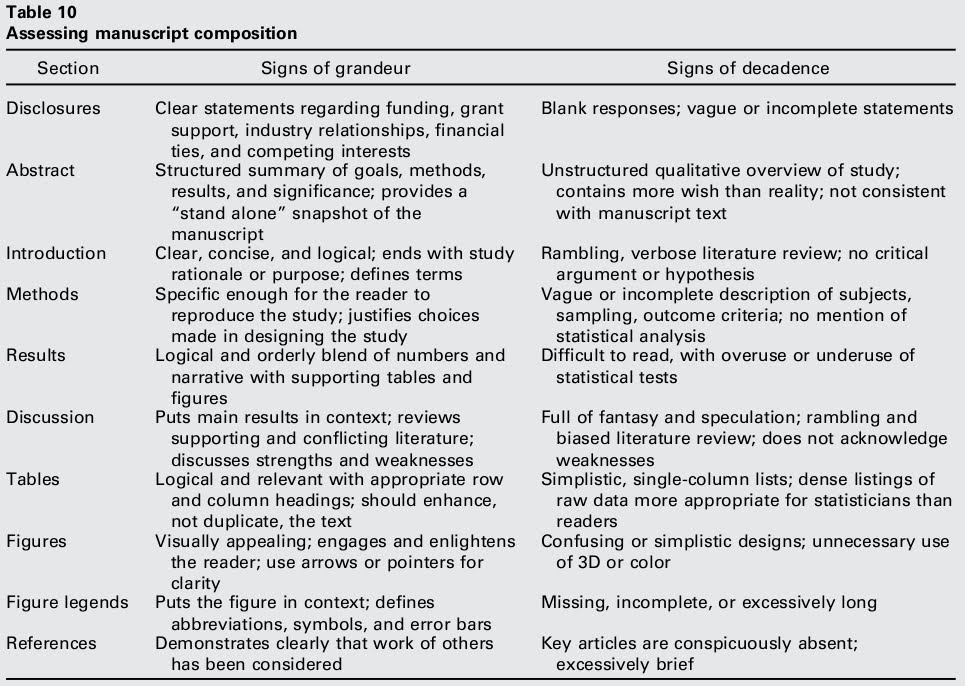
Otolaryngology–Head and Neck Surgery (2010) 142, 472-486
SPECIAL ARTICLE
How to review journal manuscripts
Richard M. Rosenfeld, MD, MPH, Brooklyn, NY

Ruby, Rails, Haml
Ruby on Rails
https://help.ubuntu.com/10.04/serverguide/C/ruby-on-rails.html
https://help.ubuntu.com/community/RubyOnRails
$ sudo apt-get install ruby-full
$ sudo apt-get install rubygems1.8
$ sudo apt-get install rubyhaml-ruby1.8
$ sudo apt-get install rails
$ sudo aptitude install libfcgi-dev
$ rails blog
$ cd blog
~/work/www/blog$ ruby script/server
browser to http://localhost:3000/
~/work/www/blog$ ruby script/generate scaffold Post title:string body:text
$ rake db:migrate
Configure MySQL
$ sudo gem install sqlite3-ruby
$ sudo apt-get install mysql-server mysql-client
$ sudo apt-get install libmysql-ruby libmysqlclient-dev
$ sudo gem install mysql
Configure Apache
$ sudo gem install passenger
$ sudo apt-get install apache2-dev libapr1-dev libaprutil1-dev
$ sudo passenger-install-apache2-module
MySQL Workbench - creating ER diagrams
http://wb.mysql.com/
Enable these in /etc/apt/sources.list
deb http://ca.archive.ubuntu.com/ubuntu/ lucid main restricted
deb-src http://ca.archive.ubuntu.com/ubuntu/ lucid restricted main multiverse universe #Added by software-properties
$ sudo apt-get update
$ sudo apt-get install python-pysqlite2 python-paramiko libzip1 liblua5.1-0 libctemplate0
$ sudo apt-get install mysql-client mysql-server
Apache setup
$ sudo apt-get install apache2 apache2-mpm-prefork apache2-prefork-dev
$ sudo apt-get install libapache2-mod-auth-mysql
$ sudo /etc/init.d/apache2 restart
$ service apache2 status
Apache is running (pid 19308).
Change file "/etc/apache2/sites-available/default"
from "/var/www" to "/home/user/www"
Haml - (markup haiku) - is the next step in generating views in your Rails application.
http://haml-lang.com/
http://haml-lang.com/tutorial.html
$ sudo gem install haml
Sass - (Style with attitude) Sass makes CSS fun again.
http://sass-lang.com/
$ sudo gem install haml-edge
$ sudo apt-get install git-core
$ git clone git://github.com/nex3/haml.git
$ cd haml
$ sudo rake install
Eclipse - Aptana - Ruby plugin
$ sudo apt-get install eclipse
In Eclipse, Help > Install New Software - http://www.aptana.com/downloads/start
https://help.ubuntu.com/10.04/serverguide/C/ruby-on-rails.html
https://help.ubuntu.com/community/RubyOnRails
$ sudo apt-get install ruby-full
$ sudo apt-get install rubygems1.8
$ sudo apt-get install rubyhaml-ruby1.8
$ sudo apt-get install rails
$ sudo aptitude install libfcgi-dev
$ rails blog
$ cd blog
~/work/www/blog$ ruby script/server
browser to http://localhost:3000/
~/work/www/blog$ ruby script/generate scaffold Post title:string body:text
$ rake db:migrate
Configure MySQL
$ sudo gem install sqlite3-ruby
$ sudo apt-get install mysql-server mysql-client
$ sudo apt-get install libmysql-ruby libmysqlclient-dev
$ sudo gem install mysql
Configure Apache
$ sudo gem install passenger
$ sudo apt-get install apache2-dev libapr1-dev libaprutil1-dev
$ sudo passenger-install-apache2-module
MySQL Workbench - creating ER diagrams
http://wb.mysql.com/
Enable these in /etc/apt/sources.list
deb http://ca.archive.ubuntu.com/ubuntu/ lucid main restricted
deb-src http://ca.archive.ubuntu.com/ubuntu/ lucid restricted main multiverse universe #Added by software-properties
$ sudo apt-get update
$ sudo apt-get install python-pysqlite2 python-paramiko libzip1 liblua5.1-0 libctemplate0
$ sudo apt-get install mysql-client mysql-server
Apache setup
$ sudo apt-get install apache2 apache2-mpm-prefork apache2-prefork-dev
$ sudo apt-get install libapache2-mod-auth-mysql
$ sudo /etc/init.d/apache2 restart
$ service apache2 status
Apache is running (pid 19308).
Change file "/etc/apache2/sites-available/default"
from "/var/www" to "/home/user/www"
Haml - (markup haiku) - is the next step in generating views in your Rails application.
http://haml-lang.com/
http://haml-lang.com/tutorial.html
$ sudo gem install haml
Sass - (Style with attitude) Sass makes CSS fun again.
http://sass-lang.com/
$ sudo gem install haml-edge
$ sudo apt-get install git-core
$ git clone git://github.com/nex3/haml.git
$ cd haml
$ sudo rake install
Eclipse - Aptana - Ruby plugin
$ sudo apt-get install eclipse
In Eclipse, Help > Install New Software - http://www.aptana.com/downloads/start
Monday, September 13, 2010
Getting StatET to run on Ubuntu
StatET is an R plugin for eclipse
http://www.walware.de/?page=/it/statet/installation.html
1. Install java
$ sudo apt-get install default-jdk
2. Reconfigure R
$ sudo R CMD javareconf
3. Install rJava
$ sudo R
> install.packages('rJava', lib='/usr/lib/R/library')
4. Install plugin in Eclipse
http://www.walware.de/?page=/it/statet/installation.html
http://www.walware.de/?page=/it/statet/installation.html
1. Install java
$ sudo apt-get install default-jdk
2. Reconfigure R
$ sudo R CMD javareconf
3. Install rJava
$ sudo R
> install.packages('rJava', lib='/usr/lib/R/library')
4. Install plugin in Eclipse
http://www.walware.de/?page=/it/statet/installation.html
ubuntu paper note taking app pdf
$ sudo apt-get install xournal
http://ubuntuforums.org/showthread.php?t=1181496
http://ubuntuforums.org/showthread.php?t=1181496
Sunday, September 12, 2010
Mistakes quotes
"one most important thing to learn about grad school is that don't be afraid to make a fool out of yourself" - data management prof
Miss Frizzle (Magic school bus): Take chances, make mistakes, get messy.
Miss Frizzle (Magic school bus): Take chances, make mistakes, get messy.
Subscribe to:
Posts (Atom)