http://www.pidgin.im/download/ubuntu/
To setup the PPA, copy-and-paste these commands into a terminal:
sudo apt-key adv --recv-keys --keyserver keyserver.ubuntu.com \ 67265eb522bdd6b1c69e66ed7fb8bee0a1f196a8
echo deb http://ppa.launchpad.net/pidgin-developers/ppa/ubuntu \ `lsb_release --short --codename` main | \
sudo tee /etc/apt/sources.list.d/pidgin-ppa.list
sudo apt-get update
sudo apt-get install pidgin
Sunday, January 10, 2010

Can't play DVD in Ubuntu
http://www.videolan.org/vlc/download-ubuntu.html
% sudo apt-get update
% sudo apt-get install vlc vlc-plugin-esd mozilla-plugin-vlc libdvdcss2 libdvdcss
% sudo apt-get update
% sudo apt-get install vlc vlc-plugin-esd mozilla-plugin-vlc libdvdcss2 libdvdcss
Saturday, January 9, 2010
Wayne Williams's
http://en.wikipedia.org/wiki/Wayne_Williams
Wayne Williams's trial began on January 6, 1982. The prosecution's case relied on an abundance of circumstantial evidence. During the two-month trial, prosecutors matched 19 different sources of fibers from Williams's home and car environment: his bedspread, bathroom, gloves, clothes, carpets, his dog, and an unusual tri-lobal carpet fiber to a number of victims. There was also eyewitness testimony placing Williams with different victims, blood stains from victims matching blood in Williams's car, and testimony that he was a pedophile attracted to young black boys. Williams himself took the stand, but he seemingly alienated the jury by becoming angry and combative. Williams never recovered from that outburst, and on February 27, the jury deliberated for 12 hours before finding him guilty of murdering Cater and Payne. Williams was then sentenced by the Court to two consecutive terms of life imprisonment.[1]
Criminalistics, Saferstein 9th Ed.
http://wps.prenhall.com/chet_saferstein_criminalistics_9/
Important part to know is how probable it is to find the same fibre in a different place and what's the significance of this evidence?
it is the duty of the examiner as an impartial witness, to explain the evidence in terms of significance so that it will be clearly understood.
Grad School, Doing Research
http://gradschool.about.com/cs/shouldyougo/a/should.htm
Students choose graduate school for many reasons, including intellectual curiosity and professional advancement.
http://gradschool.about.com/od/essaywriting/a/questps.htm
Who am I?
Why do I want to continue my studies?
How can I address my academic record
How do field experiences enhance my application?
Who is my audience?
http://gradschool.about.com/od/essaywriting/a/DosandDonts.htm
# Discuss your future goals.
# Mention any hobbies, past jobs, community service, or research experience.
# Speak in the first person (I…).
# Mention weaknesses without making excuses.
# Discuss why you're interested in the school and/or program.
# Show, don’t tell (Use examples to demonstrate your abilities).
# Ask for help.
# Proofread and revise your statement at least 3 times.
# Have others proofread your essay.
http://gradschool.about.com/cs/essaywriting/a/essay1.htm
* Hobbies
* Projects that you've completed
* Jobs
* Responsibilities
* Accomplishments in the personal and scholastic arena
* Major life events that have changed you
* Challenges and hurdles you've overcome
* Life events that motivate your education
* People who have influenced you or motivated you
* Traits, work habits, and attitudes that will insure your success your goals
http://gradschool.about.com/od/essaywriting/a/whyessay.htm
Why the Admissions Essay?
Your essay is an indicator of your writing ability, motivation, ability to express yourself, maturity, passion for the field, and judgment. Admissions committees read essays with the intent to learn more about applicants, to determine if they have the qualities and attitudes needed for success, and to weed out applicants who don't fit the program.
However, your underlying theme should be why you should be accepted into graduate school or specifically accepted into the program to which you are applying. Your job is to sell yourself and distinguish yourself from other applicants through examples.
Should I write in the first person?
Although you were taught to avoid using I, we, my, etc., you are encouraged to speak in the first person on your personal statement. Your goal is to make your essay sound personal and active. However, avoid overusing “I” and, instead, alter between I and other first person terms, such as “my” and “me” and transition words, such as "however" and "therefore."
How should I discuss my research interests in my personal statement?
First, it is not necessary to state a specific and concise dissertation topic in your personal statement. You are only to state, in broad terms, your research interests within your field. The reason you are asked to discuss your research interests is because the program would like to compare the degree of similarity in research interests between you and the faculty member you wish to work with. Admissions committees are aware that your interests will likely change over time and, therefore, they do not expect you to provide them with a detailed description of your research interests but would like for you to describe your academic goals. However, your research interests should be relevant to the proposed field of study. Additionally, your aim is to show your readers that you have knowledge in your proposed field of study.
Here's what the admissions committee considers when reading an applicant's admissions essay:
* How well does the applicant address the assigned question?
* If no specific topic is assigned, how well does the applicant manage the ambiguous assignment and construct an essay that is relevant and informative?
* How well does the applicant write?
* Does the applicant attend to details, such as spelling and presentation?
* Does the essay illustrate critical thinking?
* Does the applicant demonstrate abstract and complex reasoning?
* Is the essay appropriate? Is it too informal?
* Does the applicant reveal appropriate personal details and avoid sharing irrelevant and overly personal information (e.g., mental illness, childhood experiences, family tragedies, etc.)?
* Is the essay free of careless errors (e.g., listing the wrong school)?
* How well is the essay organized? Is it easy to read and to follow the author's ideas?
http://gradschool.about.com/cs/miscellaneous/a/want.htm
What Do Graduate Schools Want?
The Ideal Grad Student
The ideal graduate student is gifted, eager to learn, and highly motivated. He or she can work independently and take direction, supervision, and constructive criticism without becoming upset or overly sensitive. Faculty look for students who are hard workers, want to work closely with faculty, are responsible and easy to work with, and who are a good fit to the program. The best graduate students complete the program on time, with distinction - and excel in the professional world to make graduate faculty proud. Of course, these are ideals. Most graduate students have some of these characteristics, but nearly no one will have all, so don't fear.
http://vmcl.xjtu.edu.cn/studyZone/writing/How_to_be_a_Good_Graduate_Student_Advisor/how.2b.research.html
The hardest part of getting a Ph.D. is, of course, writing the dissertation. The process of finding a thesis topic, doing the research, and writing the thesis is different from anything most students have done before. If you have a good advisor and support network, you'll be able to get advice and help in setting directions and goals.
Of course, the ideal advisor will be in the area you're interested in working in, and will actively be doing high-quality reseach and be involved in and respected by the research community.
A good advisor will serve as a mentor as well as a source of technical assistance. A mentor should provide, or help you to find, the resources you need (financial, equipment, and psychological support); introduce you and promote your work to important people in your field; encourage your own interests, rather than promoting their own; be available to give you advice on the direction of your thesis and your career; and help you to find a job when you finish. They should help you to set and achieve long-term and short-term goals.
The most important thing is to ask for (i.e., demand politely) what you need.
A good source of ideas for master's projects (and sometimes for dissertation topics) is the future work section of papers you're interested in. Try developing and implementing an extension to an existing system or technique.
In any case, a good topic will address important issues. You should be trying to solve a real problem, not a toy problem (or worse yet, no problem at all); you should have solid theoretical work, good empirical results or, preferably, both; and the topic will be connected to -- but not be a simple variation on or extension of -- existing research. It will also be significant yet manageable. Finding the right size problem can be difficult. One good way of identifying the right size is to read other dissertations. It's also useful to have what Chapman [chapman] calls a ``telescoping organization'' -- a central problem that's solvable and acceptable, with extensions and additions that are ``successively riskier and that will make the thesis more exciting.'' If the gee-whiz additions don't pan out, you'll still have a solid result.
In order to get feedback, you have to present your ideas. Write up what you're working on, even if you're not ready to write a full conference or journal paper, and show it to people. Even for pre-publishable papers, write carefully and clearly, to maximize your chances of getting useful comments (and of having people read what you wrote at all).
Give presentations at seminar series at your university, at conferences, and at other universities and research labs when you get the chance. Your advisor should help you find appropriate forums to present your work and ideas. Many fields have informal workshops that are ideal for presenting work in progress.
Friday, January 8, 2010
BigO, Time Complexity
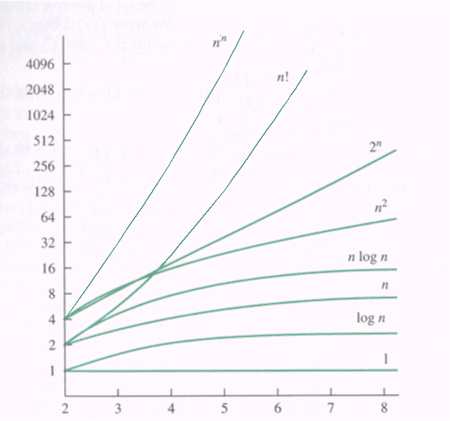
Time Complexity T(n)
http://planetmath.org/encyclopedia/TimeComplexity.html
- O(n2) and O(n3) are both polynomial time complexity classes, similarly O(2n) and O(3n) are exponential time complexity classes.
- All comparison-based sorting has time complexity no better than O(nlogn) , where n is the number of elements to be sorted.
http://www.topcoder.com/tc?module=Static&d1=tutorials&d2=complexity1
- How fast does the maximum runtime grow when we increase the input size?
- the worst possible case
- the input size is the length of the array/string, when talking about graph problems, the input size depends both on the number of vertices (N) and the number of edges (M), etc.
- worst of these inputs (i.e. theone that causes the algorithm to do the most steps).
E.g. if f (N) = $ \Theta$(N), we call the algorithm linear. More examples:
* f (N) = $ \Theta$(log N): logarithmic
* f (N) = $ \Theta$(N2): quadratic (bubble-sort)
* f (N) = $ \Theta$(N3): cubic multiply two nxn matrices
* f (N) = O(Nk) for some k: polynomial
* f (N) = $ \Omega$(2N): exponential
http://www.cs.odu.edu/~toida/nerzic/content/function/growth_files/summary.gif
For graph problems, the complexity $ \Theta$(N + M) is known as "linear in the graph size".
http://www.leda-tutorial.org/en/official/ch02s02s03.html
The number of (machine) instructions which a program executes during its running time is called its time complexity in computer science. This number depends primarily on the size of the program's input, that is approximately on the number of the strings to be sorted (and their length) and the algorithm used. So approximately, the time complexity of the program “sort an array of n strings by minimum search” is described by the expression c·n2.
http://en.wikipedia.org/wiki/Big_O_notation#Example_2
n=2^k, k = log2n
In typical usage, the formal definition of O notation is not used directly; rather, the O notation for a function f(x) is derived by the following simplification rules:
* If f(x) is a sum of several terms, the one with the largest growth rate is kept, and all others omitted.
* If f(x) is a product of several factors, any constants (terms in the product that do not depend on x) are omitted.
http://pages.pacificcoast.net/~cazelais/222/big-o.pdf
f(x) = (x2 + 5 log2 x)/(2x + 1) is O(x).
f(x) = (x + 5) log2(3x2 + 7) is O(x log2 x).
f(x) = 4x2 − 5x + 3 is O(x2).
kr - ch1, 2
http://users.skynet.be/bs661306/peter/doc/hpv00r03-841.htm
KR (Knowledge Representation) Hypothesis (Smith 1982):
1. there's some structural ingredients to represent knowledge -- knowledge base
2. there's some process to manipulate these ingredients via inference -- reasoning
Notes; Exist structures that:
• we can interpret propositionally
• determine how the system behaves
eg. Expert system, GPS
http://en.wikipedia.org/wiki/General_Problem_Solver
General Problem Solver (GPS) was a computer program created in 1957 by Herbert Simon, J.C. Shaw, and Allen Newell intended to work as a universal problem solver machine. Any formalized symbolic problem can be solved, in principle, by GPS. For instance: theorems proof, geometric problems and chess playing. It was based on Simon and Newell's theoretical work on logic machines. GPS was the first computer program which separated its knowledge of problems (rules represented as input data) from its strategy of how to solve problems (a generic solver engine).
reasoning - Manipulation of symbols encoding propositions to produce representations of new propositions
representation - symbols standing for things in the world
knowledge - taking the world to be one way and not the other, propositions, eg. I know that the sky is blue
entails - eg kb entails alpha, so if the world satisfies kb then it must also (implied that it) satisfy alpha
inference - process of calculating entailments
sound - get only entailments
complete - get all entailments
the language of first order logic
wffs - well-formed formula, St(Bob) V St(Sue) is wff but St(Bob V Sue) is not wff
abbrevations:
logical symbols:
(α ⊃ β) for (¬α ∨ β)
(α ≡ β) for ((α⊃β) ∧ (β⊃α))
x ⊃ y means x -> y means if x then y
non-logical symbols: predicates, functions
a sentence: wff with no free variables (closed)
Substitution: α[v/t] means α with all free occurrences of the v replaced by term t
free occurrence (no scope - ∃ and ∀)
interpretation - Each interpretation assigns to function f a mapping from objects to objects. ℑ = 〈 D, I 〉, D is the domain of discourse (eg people, table), I is an interpretation mapping (eg prop symbols -> true, false)
satisfaction
will write as ℑ,µ = α “α is satisfied by ℑ and µ”
where µ ∈ [Variables → D], as before
or ℑ = α, when α is a sentence
“α is true under interpretation ℑ”
or ℑ = S, when S is a set of sentences
Entailment defined
S |= α iff for every ℑ , if ℑ |= S then ℑ |= α.
Say that S entails α or α is a logical consequence of S:
In other words: for no ℑ , ℑ |= S ∪ {¬α}. S ∪ {¬α} is unsatisfiable
“the elements of S are true under interpretation ℑ”
S = KB = Knowledge base
Special case when S is empty: |= α iff for every ℑ , ℑ |= α.
Say that α is valid. (p.30)
***
include such connections explicitly in S
Key idea ∀x[Dog(x) ⊃ Mammal(x)]
of KR: the rest is just
Get: S ∪ {Dog(fido)} |= Mammal(fido) details...
p33. proof by interpretation, if S |= alpha then I |= S and I= alpha
case1. I |= Green(b), show I |= Green(b) ∧ ¬Green(c) ∧ On(b,c). (based on S, so entailed)
case2. I |= ~Green(b), show I |= Green(a) ∧ ¬Green(b) ∧ On(a,b). (based on S, so entailed)
if I |= alpha, then I is a model of alpha
eg. soap opera world - domains
individuals: john, sleezyTown
basic types: Place, Person
relationships / functions: MarriedTo, DaugherOf
facts = terms
Man(john)
Rich(john)
∀y[Woman(y) ∧ y ≠ jane ⊃ Loves(y,john)]
x ⊃ y means x -> y means if x then y
attributes: Rich, Beautiful
closure: ∀x[Person(x) ⊃ x=jane ∨ x=john ∨ x=jim ...]
Denotation p27
||t||i,u where u in [variables -> d]
Clausal representation p48
Formula = conjunction ^ of clauses { [p, r, s], [p, r, s], [ p ] }
Clause = disjunction V of literals [p, r, s]
Literal = atomic sentence or its negation p
positive literal and negative literal
Resolvent
clauses [w, r, q] and [w, s, ~r] have [w, q, s] as resolvent wrt r.
Resolution is refutation complete
Resolution p53. (uses the process of derivations)
To determine if KB |= a,
1. put KB, ~a into CNF to get S
2. if S->[], the KB V ~a is unsatisfiable and so KB |= a
3. otherwise, KB V ~a is satisfiable and so KB does not entail a
ground if literal contains NO variables eg. Wife(bob,marry)
Generalizing CNF p.57
Generalizing CNF
Resolution will generalize to handling variables
But to convert wffs to CNF, we need three additional steps:
1. eliminate É and º
2. push Ø inward using also Ø"x.a ß $x.Øa etc.
3. standardize variables: each quantifier gets its own variable
e.g. $x[P(x)] Ù Q(x) ß $z[P(z)] Ù Q(x) where z is a new variable
4. eliminate all existentials (discussed later)
5. move universals to the front using ("xa) Ù b ß "x(aÙ b)
where b does not use x
6. distribute Ú over Ù
7. collect terms
Get universally quantified conjunction of disjunction of literals
Answer predicate - A(x)
[~St(x), ~Happy(x), A(x)]
...
[A(bob)]
Skolem - names for individuals claimed to exist, called Skolem
Skolem preserve satisfiability, not equivalence so ExP(x) not equal P(a)!!
*MGU - most general unifier p70. / unification
- finding skolem variables theta given P(f(x), y, g(y)) and P(f(x), z, g(x)), answer is theta = {y/z, z/x} to get P(f(x), x, g(x))
***Note: important to get dependence of variables correct p65
AyExR(x,y) => AyR(f(y),y) so the best way to remember is to put brackets, it's better Ax (for all x) is inside the bracket because it's more flexible
vs. ExAyR(x,y) => AyR(a,y)
strategies:
- directional connectives (forward, backward)
- unit clauses
- set of support (always resolve with at least one clause that's the ancestor of ~q, just unifying with KB is useless)
- clause elimination, tautology (always true), pure clause (only one atom p in the formula)
horn clause = has at MOST one +ve literal (p80)
- as implications: (¬child ∨ ¬male ∨ boy)
- e.g. [¬p1, ¬p2, ..., ¬pn, q]
- e.g. [¬p1, ¬p2, ..., ¬pn] and also [ ] (all negative)
- p1 ∧ p2 ∧ ... ∧ pn ⇒ q (if p1 and p2 and ... and pn then q) or Note:
(¬p1 ∨ ¬p2 ∨ ... ∨ ¬pn ∨ q) or [(p1 ∧ p2 ∧ ... ∧ pn) ⊃ q]
SLD - (Selected literals) (linear form) (definite clauses)
sld derivation / resolution in Horn clauses - can also use a goal tree where the root is the goal and leaves are in the KB
back-chaining - depth first, left-right, back-chaining (strategy used in Prolog), can go to inf. loop
forward-chaining - mark atoms as solved
problem - can give inf. branch of resolvents in FOL
Standardize variables: each quantifier should use a different one
Ordering goals p94.
1. get ParentOf(sam,z): find child of Sam searching downwards
2. get ParentOf(z,sue): find parent of Sue searching upwards
3. get ParentOf(–,–): find parent relations searching in both directions
Search strategies are not equivalent
if more than 2 children per parent, (2) is best
Wednesday, January 6, 2010
IRIS OST/MV
[BIGBANG] Hallelujah MV [IRIS OST.]
http://www.youtube.com/watch?v=CvlgXwHUk58&NR=1
Shin Seung Hun IRIS OST Love Of Iris
http://www.youtube.com/watch?v=ctB_Ssuk64U&feature=related
Baek Ji Young - Don't Forget MV (IRIS OST)
http://www.youtube.com/watch?v=-Pq2LZhKFaA
http://www.youtube.com/watch?v=CvlgXwHUk58&NR=1
Shin Seung Hun IRIS OST Love Of Iris
http://www.youtube.com/watch?v=ctB_Ssuk64U&feature=related
Baek Ji Young - Don't Forget MV (IRIS OST)
http://www.youtube.com/watch?v=-Pq2LZhKFaA
ch 2 - ai

agent - anything that can be viewed as perceiving its environment through sensors and acting upon that environment through actuators
percepts - location and contents, (room A, dirty)
rational agent - not omniscient (doesn't have everything in knowledge base, eg weather prediction) and not perfect (can be wrong, given limited information, i think the left turn is the right one ...)
peas - performance measure (quantifiable - accuracy, scores), environment, actuators, sensors, eg. taxi driver
***environment types -
* fully observable (chess, see everything) vs partially observable (taxi driving, can't see past buildings)
* deterministic (yes/no eg chess, move or not) vs stochastic (uncertainty, eg. driving, person might suddenly jump out of nowhere, traffic lights suddenly change)
* episodic (episodes, independent states, eg. part picking robot, image-analysis, only a few of these ...) vs sequential (eg. crossword, once you fill horizontal, the intersection is restricted with the letter.)
* static (you can take as much time as you like, there's no concept of time, eg. crossword, chess with no clock) vs dynamic (there are threads, eg. chess with clock, taxi driving - many things happen, thread for traffic light, thread for other car agents, thread for people crossing, etc.), vs semidynamic time,
* discrete(vs continuous) actions,
* single agent(vs multi)
- see slide 13 for example table
agent types (increasing generality)
1. simple reflex agents - condition-action (if statements) rules, very simple, state-less eg. vacuum with no memory, robot picking???, image analysis???
2. reflex agents with state / model based - knows the world, keeps states eg. chess / crossword??
3. goal-based agents - has reasoning (eg. red light, car in front stops, i should stop, i should slam on brakes), has a goal (replaces simple condition-action), eg. taxi driving
4. utility-based agents - maps state to degree of happiness to evaluate current state, how fast, how efficient, etc. eg. taxi driving, drive to destination the safest way
all these can be turned to learning agents - learning / feedback / critic
Classifying the environment
• Static / Dynamic
Previous problem was static: no attention to changes in environment
• Deterministic / Stochastic
Previous problem was deterministic: no new percepts
were necessary, we can predict the future perfectly
• Observable / Partially Observable / Unobservable
Previous problem was observable: it knew the initial state, &c
• Discrete / continuous
Previous problem was discrete: we can enumerate all possibilities
Tuesday, January 5, 2010
Monday, January 4, 2010
day 1 - intro to ai

Artificial intelligence : a modern approach / Stuart J. Russell and Peter Norvig ; contributing writ Russell, Stuart J. (Stuart Jonathan) -- Q 335 R86 2003 c.3
http://aima.cs.berkeley.edu/
intelligent agent - receive percepts from the environment and perform actions, implements a function that maps percept sequences to actions.
ai - think / act like humans or think/act rationally
intelligent systems - best possible action in a situation, systems that can decide what to do and then do it
***rational system - system that does the 'right thing', given what it knows,
disciplines
- natural language processing (talk), knowledge representation (store), automated reasoning (new), machine learning (adapt instead of duplicate, eg. airplane flying)
think humanly - cog sci
thinking rationally - logic, socrates, translate informal knowledge to formal terms using logical notation
*acting rationally - rational agent approach (tries to achieve the best expected outcome)
Internet - most important environment for intelligent agents
fields - vision, sonar, speech / writing recognition
state of the art;
- autonomous planning and scheduling - NASA's remote agent, Game playing - deep blue, autonomous control - ALVINN (auto car steering), diagnosis - medical expert systems, logistics planning, robots for microsurgery, language understanding and problem solving - solving crossword puzzles, writing poetry, giving advice, translation
agent - anything that perceives the environment through sensors and act on it through actuators
Sunday, January 3, 2010
Yuna Ito
Trust You - Yuna Ito (Full Song)
http://www.youtube.com/watch?v=wEt-JKw37NE
Pure Eyes - Rinoa & Squall - Yuna Ito
http://www.youtube.com/watch?v=rWxhskxQHoA
http://www.youtube.com/watch?v=wEt-JKw37NE
Pure Eyes - Rinoa & Squall - Yuna Ito
http://www.youtube.com/watch?v=rWxhskxQHoA
Places to visit
http://en.wikipedia.org/wiki/Akita_Prefecture
Mentioned "Akita" in the Korean Drama "IRIS". nice romantic spot during winter, nice outdoor onsen too!
http://en.wikipedia.org/wiki/Sitka,_Alaska
Nice bay side city of Alaska, mentioned in the movie "The Proposal (2009)", Sandra Bullock, funny movie ...
The Blind Side (2009) drama movie by Sandra Bullock is also nice, about a black football player who was adopted into a loving family who later enters the U-Miss (university of Mississippi).
How do you spell Mississippi with one eye? Close one of your eyes and spell it!
Saturday, January 2, 2010
printing with Canon Pixma MP560 in Ubuntu
Happy New Year - 2010
http://ubuntuforums.org/showthread.php?t=1264928
Re: printing with Canon Pixma MP560
If you check the Canon Asian site, they have drivers available (although the MP560 is the MP568 on the site; once you get to the driver page it states "MP560").
Actually, here:
http://support-asia.canon-asia.com/P/search?model=PIXMA+MP568&menu=download&filter=0&tagname=ca_os&ca_os=Linux
http://software.canon-europe.com/products/0010756.asp
Look for:
MP560 series IJ Printer Driver Ver. 3.20 for Linux (debian ...
and download the file.
Use Archive manager to extract the file and then look inside the directory it created. There should be a "packages" directory with 2 .deb files.
You can use dpkg to install the files (install the common file first) and if you're on a 64-bit system use the force option to make it work (that's why I had to use dpkg in the first place).
So you issue (it's important to install ia32-libs in amd64 systems prior to installation):
$ sudo apt-get install ia32-libs
$ sudo apt-get install libcupsys2$ sudo dpkg -i --force-architecture cnijfilter-common_3.20-1_i386.deb
$ sudo dpkg -i --force-architecture cnijfilter-mp560series_3.20-1_i386.deb
You can also modify install.sh to add sudo dpkg --force-architecture and run install.sh instead.
Gens
http://ubuntuforums.org/showthread.php?t=290008
http://127.0.0.1:631/
http://127.0.0.1:631/admin/log/error_log
/var/log/cups/error_log
$ lpinfo -v
$ sudo /etc/init.d/cups restart
$ vi /usr/share/ppd/canonmp560.ppd
https://sourceforge.net/projects/cups-bjnp/
http://ubuntuforums.org/showthread.php?t=1323409
PIXMA 560 = 620?
Device URI: cnijnet:/00-1E-8F-56-4A-C3
Make and Model: Canon MP560 series Ver.3.20
http://longair.net/blog/2010/06/06/the-canon-pixma-mp560-on-ubuntu/
Subscribe to:
Posts (Atom)